Custom clone app development in NYC allows entrepreneurs and businesses to quickly replicate proven marketplace models like Uber, Airbnb, or Tinder while tailoring the branding, code, and features for the local New York market. Choosing a local development partner ensures your product adheres to critical regional regulations, such as the NY SHIELD Act for data privacy
For startups looking to validate ideas, reduce risk, and launch quickly with a scalable solution, custom clone app development is often the smarter investment.
This blog covers a detailed guide on Custom Clone App Development in NYC
What Is Custom Clone App Development and What does it Include?
Custom clone app development refers to building a white-label app based on the core functionality of any successful platform across any industry. Unlike ready-made scripts, custom clone apps are tailored to your brand’s goals and budget, with modifications to brand name, design, logo, features, and user experience.
Custom clone app development services usually include:
UI/UX Design
The development team generates brand-appropriate wireframes, user flows, and unique interfaces. A smooth, engaging experience is the aim.
Customized Development
Developers design the frontend, backend, databases, and admin panel and customize the business logic to meet your needs. This guarantees a unique app.
API Integration
Integration of payment gateways, maps, alerts, analytics, and CRM tools improves functionality and simplifies operations.
Tests and QA
For bug-free functioning across devices, the app is tested for speed, security, and usability before launch.
Deployment
The app is distributed to the app Store, Google Play, or cloud servers with all settings and setups after testing.
Maintenance and Support
For app security and competitiveness, post-launch services include updates, bug repairs, performance monitoring, and feature additions.
Why Are NYC Businesses Investing in Custom Clone Apps?
Startups in New York are embracing custom clone apps because it eliminate the necessity to spend months and years to validate a concept. Here are some key reasons why businesses are investing in custom clone apps:
Faster Launch
Businesses can launch products more quickly than if they built from scratch since the basic functionality already exists. This accelerates startup growth and consumer acquisition.
Lower Development Costs
For startups and SMBs, custom clone creation saves time and money by not implementing every feature from scratch.
Proven Business Models
Uber, Airbnb, and DoorDash have shown market demand. Building on these models minimizes risk and boosts success.
Easier scaling
Custom clone applications are designed for expansion. New features, integrations, and services can be added without rewriting the platform as your user base grows.
Better ROI
Businesses can generate income faster and increase ROI by lowering development costs and time-to-market.
Is It Legal to Build a Clone App In New York City ?
Yes. Building a clone app is legal as long as you copy the business idea and features, not the original app’s code or brand.
What Can and Cannot Be Copied?
You can copy:
- Features and workflows
- Business models
- User journeys
You cannot copy:
- Source code
- Logo and brand name
- Color theme and design assets
- Proprietary technology and copyrighted content
Why Does IP (Intellectual Property) Matter?
Uber and Airbnb own code, logo, and branding. That’s why companies like Clone App Development Company don’t copy and paste existing applications; they develop their own code and create original designs.
Why Customization Matters?
You can brand your startup and stand out with customization. The idea is to emulate popular applications, not imitate them.
Simply said, you can develop an Uber-like app but not name it Uber or replicate its code or logo.
What Types of Apps Can Be Built as Custom Clones In NYC?
Custom clone app development isn’t limited to a few popular platforms. Businesses in NYC can build clone apps across almost any industry by adapting proven business models to their own target market. Here are some of the most common categories:
Transportation and Mobility Apps
Food Delivery and Grocery Apps
- DoorDash
- Uber Eats
- Instacart
- Grubhub
Healthcare and Telemedicine Apps
- Practo
- Zocdoc
- Teladoc
- HealthTap
Dating and Social Networking Apps
- Tinder
- Bumble
- Hinge
- OkCupid
Vacation Rental and Property Marketplace Apps
Home Services and Freelance Marketplace Apps
- TaskRabbit
- Thumbtack
- Fiverr
- Upwork
E-Commerce and Marketplace Apps
- Etsy
- Amazon
- eBay
- Poshmark
AI Chatbot and Virtual Assistant Apps
- ChatGPT
- Character.AI
- Replika
- Claude
Adult AI and Companion Apps
- Candy AI
- DreamGF
- CrushOn.AI
- Janitor AI
Beauty, Fitness, and Wellness Apps
- ClassPass
- Mindbody
- MyFitnessPal
Pet Care and On-Demand Service Apps
- Rover
- Wag!
- Handy
- Urban Company
With custom clone app development, businesses can use these proven app models as inspiration while adding their own branding, features, and monetization strategies to create a unique product.
What Customizations Can You Add to a Clone App in NYC?
Flexibility is one of the main benefits of developing a custom clone application. Businesses can change nearly every aspect of the app to align with their market and brand goals.
Branding & UI/UX
You can totally change the app with your logo, colors, layouts, and user experience to establish a distinct brand.
AI Features
Modern clone applications can include features such as AI suggestions, chatbots, dynamic pricing, and smart search.
Payment Gateway
Businesses can also add Stripe, PayPal, Apple Pay, Google Pay and country-specific payment options to make transactions easier.
Characteristics Based on Location
Businesses headquartered in NYC can add borough-specific delivery zones, local taxes, different languages and geo-targeted services.
Subscriptions and Membership
You can also generate new income streams via premium plans, loyalty programs, and recurring subscriptions.
Analytics & Admin Settings
With advanced dashboards, organizations can measure income, monitor user activity, manage orders and make data-driven choices.
How To Build A Custom Clone App In NYC: A Step-By-Step Process
NYC startups can launch faster, reduce development risks, and scale proven app ideas using this step-by-step Custom Clone App development process:
Define Your Business Goals & Idea
Choose an app model, target consumers, important features, and monetization approach. This stage reduces development expenses and feature bloat.
Research the Market and Competitors
To learn what people want and how your platform can stand out, analyze competitive applications, user reviews, and market gaps. This guarantees you’re creating a wanted product.
Branding and UI/UX Design
Logos, wireframes, user flows, and unique interfaces should represent your brand. Focus on creating a distinct experience rather than replicating the original software.
Platform Development and Customization
Build the frontend, backend, admin panel, and APIs with business-specific functionality. The clone becomes a customized product here.
Integrate Third-Party Services
Integrate payment gateways, maps, alerts, analytics tools, and AI to automate and enhance functionality.
Test and Launch Your App
Perform performance, security, and usability testing before publishing on the App Store and Google Play. Testing enables a seamless user experience.
Monitor Performance and Scale
Check customer input, repair errors, and update periodically after launch. You can add features and extend the platform without rebuilding as your company expands.
Cost of Custom Clone App Development in NYC
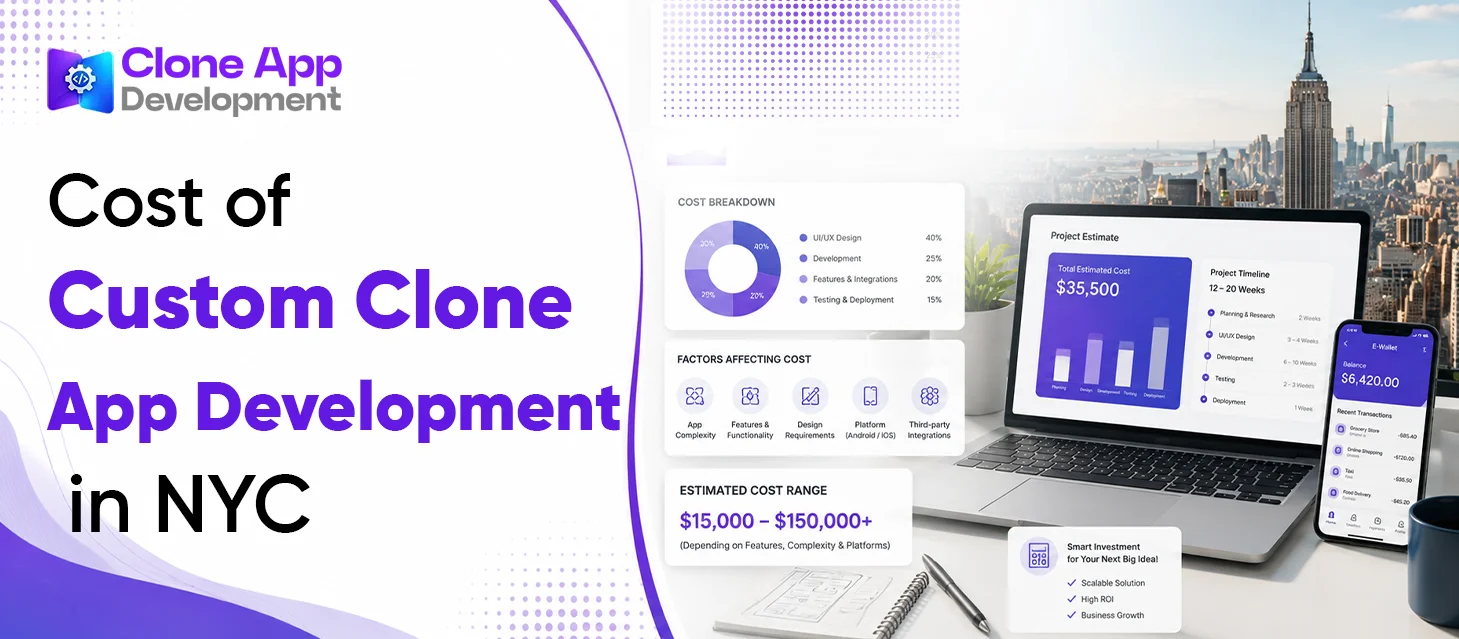
Custom clone app development in NYC costs depend on customization, functionality, and scalability. Advanced platforms with AI and bespoke integrations cost more but have more growth potential and long-term value than basic clone applications.
| Clone App Type | Estimated Cost (USD) | Timeline |
| Basic Clone App | $5k – $15k | 2–3 Months |
| Standard Custom Clone | $15k – $40k | 3–6 Months |
| Advanced Clone Platform | $40k – $80k | 6–9 Months |
| Enterprise Clone Solution | $80k – $150k+ | 9–12 Months |
Factors Affecting Development Cost
- App complexity and features
- iOS, Android, or cross-platform development
- Third-party integrations and APIs
- AI and automation capabilities
- Maintenance and post-launch support
Should You Choose Ready-Made Scripts or Custom Clone Development?
Businesses entering the market quickly often face a common question: Should I buy a ready-made clone script or invest in custom clone development? If you are also among them, this comparison table will help you make the right choice-
| Factor | Ready-Made Scripts | Custom Clone Development |
| Initial Cost | $5k and $15k | $15k –$60k + |
| Launch Time | 60-90 days | 3–9 months |
| Customization | Limited | Fully customizable |
| Branding | Basic changes | Unique brand identity |
| Scalability | Limited | Built for growth |
| Security | Depends on the vendor | Higher control |
| Source Code Ownership | License-based | Complete ownership |
| Maintenance | Vendor-dependent | Flexible |
| Long-Term Growth | Restricted | Future-proof |
Ready-Made Scripts vs. Custom Clone Development- When to Choose
The right choice depends on several parameters.
Choose Ready-Made Scripts If:
- Need a faster launch.
- Have a limited budget.
- Want to test an idea quickly.
- Need only basic features.
- Prefer lower upfront costs.
Choose Custom Clone Development If:
- Need unique features and branding.
- Plan to scale the business.
- Want full source code ownership.
- Need AI or advanced integrations.
- Focus on long-term growth.
In Simple Terms
- Ready-made scripts = Faster and cheaper to start.
- Custom clone development = More scalable and future-ready.
Conclusion
Want to build a custom clone app in NYC without starting from scratch? Team up with Clone App Development!
From Uber and Airbnb clones to AI-powered platforms and niche-focused markets, we assist startups with tailor-made clone solutions featuring unique branding, advanced functionality, and long-term support.